
We help our customers leverage product and process development by offering expertise in the areas of CFD, plasma, and FEA. Every year we deliver our services to close to 200 customers in 500 projects.
FS Dynamics solves simulation problems in which plasma behaviour has a direct effect on product performance, process efficiency, equipment lifetime or operational safety.
Self-consistent coupling between electromagnetic fields, charged particles, neutral species, and radiation emission and absorption makes plasma dynamics inherently complex. As a result, there is no single modelling approach that can accurately and efficiently describe every plasma system. The appropriate model therefore depends on the physical regime and the engineering decision the simulation must support.
A spatially averaged global model may be the fastest way to screen operating conditions. A particle-in-cell model may be required to resolve sheath dynamics and ion-energy distributions. A plasma-fluid or radiation-hydrodynamics model may be needed when transport, geometry, heat transfer and radiation dominate system behaviour.
Our role is to identify the physics that matter, select an appropriate level of fidelity and deliver results that can be used to improve the process or design. This helps customer in having a better-defined operating windows and a clearer understanding of how plasma conditions affect system performance.
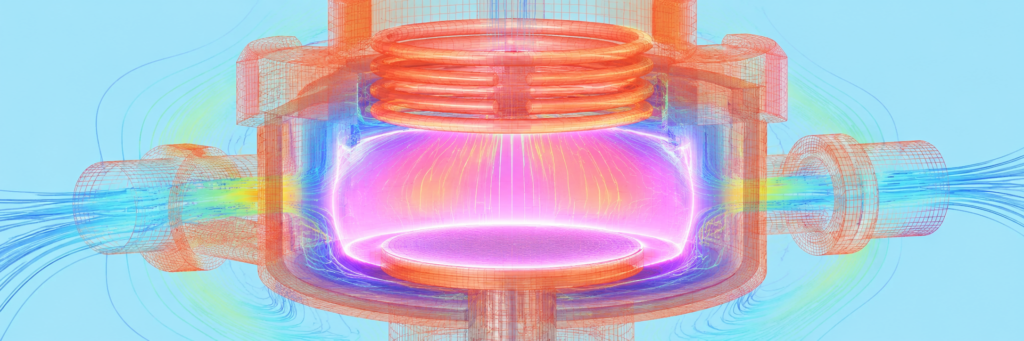
Plasma modelling covers a wide range of physical regimes and industrial applications. The examples below illustrate the types of questions that computational plasma analysis can address.
We model the formation and loss of electrons, ions, radicals, excited states and neutral species through collisional and radiative processes. This helps identify the dominant reaction pathways and determine how pressure, power, gas composition and temperature influence the plasma.
Typical outputs include species densities, ionisation fractions, reaction rates, characteristic timescales and the relative importance of competing chemical mechanisms.
machines can’t handle — and that simpler models get wrong.
We analyse how chamber geometry, gas delivery, pumping, electromagnetic excitation and surface interactions affect plasma distribution. These simulations can be used to investigate non-uniform treatment, edge effects, localised heating and sensitivity to operating conditions.
The results support equipment development, reactor scaling and the optimisation of process consistency across the treated area or material volume.
Near solid surfaces, plasma behaviour is controlled by thin sheath regions that accelerate charged particles and influence the energy delivered to the wall. We use kinetic and reduced-order methods to investigate ion bombardment, electron transport and plasma–surface interaction.
Relevant outputs include ion-energy and ion-angle distributions, particle fluxes, sheath potential, surface charging and energy deposition. These quantities are important when evaluating etching, deposition, erosion, sputtering and material damage.
We model the interaction between electromagnetic fields and the plasma to understand how energy is deposited within a discharge. Applications can include radio-frequency, microwave, inductively coupled and other electrically driven plasma systems.
Simulation can identify inefficient power coupling, localised field concentrations and operating conditions associated with unstable or non-uniform plasma behaviour.
For high-pressure and high-temperature systems, we simulate plasma flow together with Joule heating, radiation, turbulence, material heating and, where relevant, phase change or ablation.
These analyses can be used to study electric arcs, plasma torches, welding processes, metallurgical reactors and high-enthalpy flows. Typical outputs include temperature and velocity fields, current density, voltage, radiative heat transfer and thermal loads on surrounding components.
Pulsed systems can involve rapid changes in electron energy, ionisation, electromagnetic fields and chemical composition. Time-dependent simulations help explain ignition, extinction, afterglow chemistry and the transition between operating regimes.
The results can support pulse-shape optimisation, power-supply specification and the control of energy deposition into the plasma or treated material.
For radiation sources and high-temperature arc systems, we couple plasma dynamics with radiative transport and hydrodynamics. This is relevant to high-energy-density plasmas, fusion-related applications, strong shocks and systems involving rapid heating or material ablation.
The objective is to predict not only the plasma state but also the resulting pressure waves, heat loads, emission spectra, and material response.
We adapt the modelling workflow to your application, available data and engineering objectives. Most plasma simulation projects follow three main stages.
Before selecting a plasma model, we understand better your system conditions: we learn about the system type, relevant pressures, temperatures, length scales, timescales, electromagnetic conditions and collision processes. This helps identifying whether the problem requires a global, kinetic, fluid or coupled multiphysics approach. Then, we determine what the simulation must explain or predict: is the objective to improve process uniformity, determine wall loads, compare reactor concepts, investigate arc-material interaction or define a stable operating window?
Defining the real question at the beginning prevents unnecessary model complexity and ensures that the outputs can support a practical decision.
We define the geometry, reaction mechanisms, material properties, boundary conditions and plasma excitation. We then select the numerical methods needed to represent the relevant physics.
Where possible, the model is compared with experimental measurements, analytical limits, published benchmark cases or results from a second modelling approach. Sensitivity studies are used to identify uncertain inputs and establish which assumptions have the greatest effect on the result.
The model should not behave as a black box. Its assumptions, limitations and expected accuracy must be understood.
Electron density, reaction rates and field distributions are useful only when they answer the engineering question.
We interpret the results in terms of process performance, operating limits, equipment geometry, material exposure and design trade-offs. Deliverables can include recommended operating ranges, comparisons between design alternatives, identified loss mechanisms and proposals for additional measurements or model development.
You receive conclusions and recommendations, not only simulation files and colour plots.
We are method-agnostic by principle. Plasma models vary significantly in physical fidelity and computational cost, so the appropriate platform depends on the pressure regime, geometry, plasma chemistry, characteristic scales and required outputs.
Different methods may also be coupled or used in sequence. A global model can screen hundreds of conditions before selected cases are investigated with a detailed fluid or particle simulation.
Collisional-radiative models describe populations of atomic, ionic and molecular states by accounting for processes such as electron-impact excitation, ionisation, recombination, spontaneous emission and radiation absorption.
We use these models when excited-state populations, charge-state distributions or emitted radiation are important. Applications include plasma diagnostics, high-temperature plasmas, fusion-related systems, spectroscopy and radiation-source development.
They are particularly useful when local thermodynamic equilibrium cannot be assumed and the plasma state cannot be described by temperature alone.
Global models, also known as zero-dimensional or volume-averaged models, solve particle and energy balances without resolving the complete spatial distribution inside the reactor.
We use them for rapid process screening, reaction-mechanism development, operating-window studies and sensitivity analysis. Because they are computationally efficient, they can assess large combinations of gas composition, pressure, power, flow rate and wall conditions.
Global models are also valuable as a first step before a more computationally intensive spatial simulation.
Kinetic methods represents charged particles as computational particles moving through self-consistent electromagnetic fields.
We use kinetic simulations methods where non-equilibrium particle behaviour is essential, particularly in low-pressure plasmas, sheath regions, particle-magnetic field interaction, beam–plasma interactions and systems in which the particle velocity distribution cannot be represented accurately by a fluid approximation.
Plasma-fluid models treat electrons, ions and neutral species through conservation equations for mass, momentum and energy. These equations can be coupled with electrostatic or electromagnetic field equations, chemical kinetics, gas flow and heat transfer.
We use fluid approaches when spatial distributions and reactor-scale transport are important, but resolving individual particles would be unnecessarily expensive. Typical applications include plasma reactors, atmospheric-pressure discharges, thermal plasmas and electrically conducting flows.
Radiation-hydrodynamics couples material motion and thermodynamic behaviour with the transport and exchange of radiative energy. Depending on the application, it can also include ionisation physics, electromagnetic effects, shocks, material ablation and non-equilibrium radiation.
We use this approach when radiation is a major part of the system’s energy balance and directly affects plasma evolution. Applications can include high-energy-density plasmas, pulsed-power systems, fusion-related phenomena, high-enthalpy flows and strongly radiating shocks.
One method does not always provide the complete answer. We can use reduced-order models to define operating regimes, pass reaction coefficients from collisional-radiative calculations into fluid models, or derive boundary conditions from particle simulations for reactor-scale analyses.
This multiscale approach concentrates computational effort where it adds value while preserving the interactions needed to represent the complete system.
Plasma technologies operate across very different pressures, temperatures and spatial scales. In each sector, the simulation approach must reflect both the plasma physics and the industrial decision it needs to support.
Plasma is central to semiconductor etching, deposition, chamber cleaning, ion implantation and surface activation. The properties of the plasma determine which reactive species reach the wafer, their energy and direction, and how uniformly the surface is processed.
Simulation can be used to study plasma uniformity, gas-phase chemistry, radical generation, sheath behaviour and ion-energy distributions. It can also help assess chamber geometry, gas-inlet configuration, electromagnetic power coupling and sensitivity to pressure, power and gas composition.
The objective is improved process consistency, selectivity, throughput and control while reducing contamination and damage to sensitive structures.
Plasma forms the fuel in magnetic- and inertial-confinement fusion systems. Its behaviour determines confinement quality, energy losses, material exposure and the conditions required to sustain fusion reactions.
Plasma simulations can support studies of atomic processes, impurity radiation, plasma–wall interaction, edge and sheath behaviour, fuel-cycle processes and radiation transport. Radiation-hydrodynamics can also be used for rapidly compressed or high-energy-density plasmas.
The results help quantify power balance, radiative losses, particle transport and heat loads on plasma-facing components.
Plasma is used to clean, activate, functionalise, coat, etch and modify material surfaces. These treatments can improve adhesion, wettability, corrosion resistance, hardness, biocompatibility and other surface properties without changing the entire bulk material.
Simulation can predict the production and transport of reactive species, ion and radical fluxes to the surface, energy deposition and treatment uniformity. It can also help investigate the effects of part geometry, electrode arrangement, pressure, gas composition and exposure time.
The objective is a repeatable treatment with the required surface properties and minimal thermal or physical damage.
Plasma systems are used in melting, refining, remelting, cutting, welding, spraying and the treatment of metal powders and ores. These processes often involve electric arcs, high-temperature jets, radiation, molten materials and strong heat transfer.
Simulation can be used to study arc attachment, torch performance, electromagnetic forces, plasma flow, metal heating and radiative losses. Coupled models can also predict melt-pool behaviour, electrode erosion and thermal loading of furnace or torch components.
The results support process stability, energy efficiency, material quality and equipment lifetime.
Thermal and non-thermal plasmas can destroy hazardous compounds, treat exhaust streams, convert waste into syngas or vitrified products, and remove pollutants from industrial gases.
Simulation can describe the creation of reactive species, pollutant-destruction pathways, gas heating, mixing and residence time. For plasma torches and high-temperature reactors, it can also quantify energy transfer, radiation and wall loads.
The objective is to maximise destruction or conversion efficiency while controlling energy consumption, by-products, material wear and emissions.
Electric propulsion systems use plasma to ionise and accelerate propellant, producing thrust with a high specific impulse. Examples include Hall-effect thrusters, ion engines and other electromagnetic or electrothermal propulsion concepts.
Particle and fluid simulations can be used to investigate ionisation, electron transport, sheath formation, electromagnetic acceleration and plume expansion. They can also predict ion-energy distributions and charged-particle interactions with thruster walls or spacecraft surfaces.
The results support improvements in thrust efficiency, propellant utilisation, discharge stability and component lifetime.
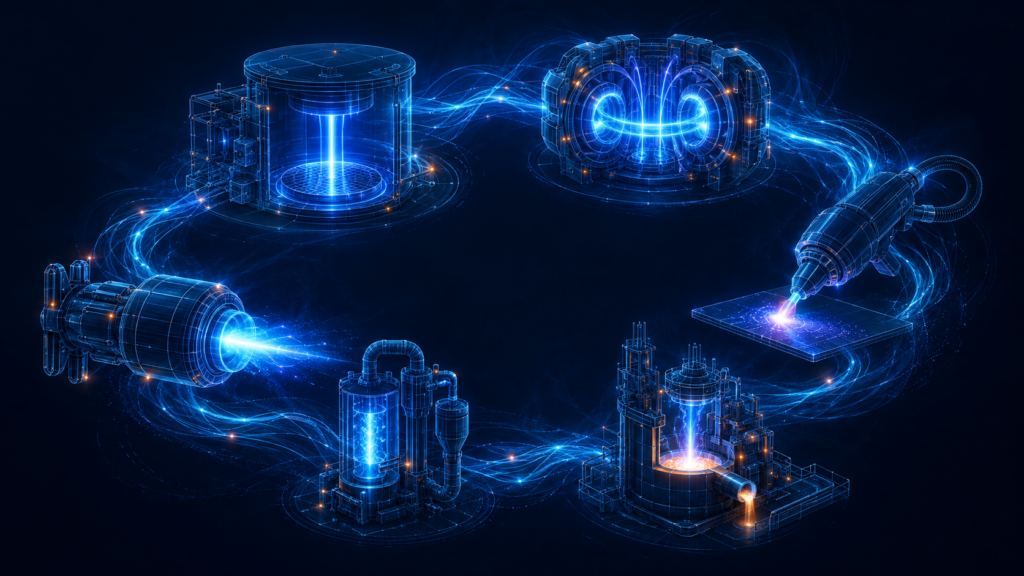
The most detailed plasma model is not automatically the most useful. We identify the minimum level of physics needed to answer the engineering question reliably.
The most detailed plasma model is not automatically the most useful. We identify the minimum level of physics needed to answer the engineering question reliably.
Sometimes that means a rapid global model. Sometimes it means resolving kinetic particle behaviour or coupling plasma dynamics with radiation, fluid flow and material response. The method follows the problem — not the other way around.
A plasma model must ultimately provide information that a process, equipment or product team can use. We translate microscopic processes such as excitation, ionisation and sheath formation into quantities such as treatment uniformity, wall heat flux, process rate and equipment lifetime.
Plasma simulations often depend on uncertain reaction rates, surface coefficients and boundary conditions. We document these assumptions and use sensitivity analysis to determine how strongly they affect the conclusions.
We will also explain when additional measurements, diagnostics or physical testing are needed to make a reliable decision.
Our expertise ranges from state-resolved atomic kinetics and zero-dimensional chemistry to particle, fluid and radiation-hydrodynamics simulations. This allows us to build modelling workflows that connect the relevant scales rather than forcing every application into one numerical method.
The appropriate method depends on the pressure, geometry, characteristic length and time scales, degree of thermodynamic equilibrium and outputs you require. Global models are efficient for chemistry and operating-window studies. Fluid models resolve reactor-scale distributions. Particle-in-cell models describe kinetic behaviour and plasma sheaths. Collisional-radiative models resolve atomic and molecular populations, while radiation-hydrodynamics is needed when radiative energy transport and material motion are strongly coupled. We assess the physical regime during project scoping and recommend an appropriate approach.
A simulation can be developed without a complete experimental dataset, but measurements improve validation and reduce uncertainty.
Useful inputs may include voltage and current histories, absorbed power, pressure, gas flow, optical-emission spectra, electron density, electron temperature, species concentrations, surface measurements or component temperatures.
Where direct data are unavailable, we can use analytical limits, benchmark cases and sensitivity studies to assess model reliability.
The timeline depends strongly on the method and the maturity of the available inputs.
A reduced-order feasibility or parameter-screening study may take a few weeks. A detailed reactor-scale fluid analysis, kinetic particle simulation or coupled radiation-hydrodynamics programme may require several months.
We define the modelling stages, expected outputs and decision points before the project begins.
Simulation can reduce the number of experiments, guide diagnostic placement and help interpret measurements, but it does not eliminate the need for validation.
The strongest development programmes combine simulation and testing. Simulation explains mechanisms and explores conditions efficiently, while experiments confirm the behaviour of the real system.
Yes. Plasma behaviour is frequently connected to gas flow, thermal transport, electromagnetic fields and material response.
Depending on the application, plasma outputs can be coupled directly with CFD and heat-transfer models or transferred as loads and source terms. Predicted pressure, temperature, electromagnetic force and heat-flux distributions can also provide inputs for structural and lifetime analyses.
Whether you need a rapid feasibility model, a detailed investigation of plasma chemistry or a coupled multi-physics simulation of an industrial system, we can help define an approach that fits the question.
Tell us about your plasma process, equipment or development challenge, and we will identify the physics, modelling method and outputs needed to move the project forward.
FS Dynamics company group including FS Dynamics Sweden AB, FS Dynamics Finland Oy AB, FS Dynamics Norway AS, FS Dynamics Portugal Lda, FS Dynamics Germany GmbH, hereby denoted FS Dynamics, is committed to protecting and respecting your privacy. This privacy policy describes how we collect and use your personal data when you apply for a job or get in touch with us regarding a job application. It also describes the choices available to you regarding our use of your personal data.
Please read this privacy policy before submitting your application. By submitting your application, you accept this privacy policy and our processing of your personal data.
FS Dynamics is the responsible entity (controller) for the processing of your personal data as described herein.
Please do not hesitate to reach out to quality@fsdynamics.eu if you have any questions or comments regarding your privacy.
PERSONAL INFORMATION THAT WE PROCESS
During the recruitment process, we will collect and process personal data about you. Depending on the circumstances, such personal data may include the categories of data listed below. Please note that the examples listed under each category are not exhaustive.
Personal data
• Contact details, such as your email address, telephone number and postal address.
• Individual data, such as your name, gender, date of birth, personal identification number or other identifier, marital status, preferred language, nationality, passport information, food preferences, hobbies.
• Professional skills and application data, such as skills and competencies, language capabilities, resume, cover letter, previous and relevant work experiences, other experiences, academic background, grades, transcripts, professional certifications, job preferences and type of employment sought, references, letter of recommendations and any other information you include in your application.
• Interview and reference data, such as notes taken during interviews and from references, assessments of capabilities, current and historic salary details together with salary and benefits expectations, and any other information you or your references provide us with.
• Test data, such as information and results from any tests you perform during the recruitment process, for example related to your personality, intelligence and skills.
• Correspondence data, such as personal information provided by email, regular mail or other means, letters of offer and acceptance of employment.
Other data. We may also collect and process any other relevant information you share with us about yourself in the course of your application. Please note that we receive any information you send to us.
Sensitive data
We will only collect sensitive personal data (such as racial or ethnic origin, political opinions, religion, health, or the like) if there is a clear reason for doing so. For example, if you have physical limitations or special needs that require us to make specific considerations during the recruitment process. We do this to enable our candidates to apply for jobs with us and to ensure that we comply with regulatory obligations placed upon us with regard to our hiring. Because email communications are not always secure, we encourage you to not include sensitive data in your emails to us.
HOW WE GATHER YOUR PERSONAL INFORMATION
Information you give to us
Most of the information FS Dynamics collects about you is received directly from you, for example from your application and during interviews. You can always choose not to provide us certain information. However, not providing requested personal data may affect or prevent us from evaluating your application or consider you as a candidate.
Information we collect about you
FS Dynamics may also collect personal data about you from third parties, such as professional recruiting firms, your references and prior employers. Sometimes we may also obtain personal data from publicly available sources, [such as your profile on LinkedIn, Facebook and other publicly available information].
HOW YOUR INFORMATION WILL BE USED
FS Dynamics will process your personal data in a conventional and regular recruitment manner. For example, we may need to process your data to enter into a contract with you regarding the employment. This also includes taking steps prior to entering into a contract with you.
FS Dynamics also have a legitimate interest in processing your personal data during the recruitment process and for keeping records of the process. Processing data from job applicants allows us to manage the recruitment process, assess and confirm a candidate’s suitability for employment and choose between candidates.
FS Dynamics will process your personal data for the following purposes:
To manage all aspects of the recruitment process
Your personal data will be used to manage your job application, to assess qualifications and evaluate performance in interviews and tests, determine eligibility for initial employment, including the verification of references, qualifications and performance.
To communicate with you
Your personal data (e.g. your email and phone number) will be used to communicate with you before, during and after the recruitment process. For example, in order to schedule interviews and tests, provide you with feedback and inform you of other open positions at FS Dynamics.
To consider you for other positions
We may use your personal data to consider you for other positions than the one you are applying for, or for potential future roles. If you are not interested in any other positions, please reach out to us and let us know you wish to be excluded.
To comply with legal obligations and legal process
We may need to process your personal data to ensure that we are complying with our legal obligations. For example, we need to check a successful applicant’s eligibility to work in the considered country before employment starts. We may also need to process data your personal to respond to and defend us against legal claims.
To manage your employment with us
In the event of your application resulting in the offer and your acceptance of a position at FS Dynamics, the data collected will become part of your employment record and will be used for employment purposes, in accordance with our employee privacy policy.
HOW WE SHARE YOUR INFORMATION
FS Dynamics may share your personal information with our employees and other trusted parties, to the extent required to manage the recruitment process:
Our employees
Your information will be shared internally for the purposes of the recruitment process, and to manage our daily business operations. However, we will restrict access to those of our employees who need it to perform their jobs, such as individuals performing administrative functions, HR and any other members of staff involved in the recruitment process.
Group Companies
We may share your personal information with other group companies for purposes connected with your application or the recruitment process.
Service providers
We may transfer or share your personal data with suppliers and subcontractors that supply services to us which require the processing of your personal data. For example, third party service providers may provide us with recruiting software systems or assist us in the recruiting process, including interviewing, administering tests and evaluating candidates. We may also engage legal and other professional advisers. Please note that our suppliers and subcontractors are not authorized to use or disclose your personal data except as necessary to perform services on our behalf, or to comply with legal requirements.
Legal purposes
Sometimes legal purposes may require us to share information about you, for example if required by law, legal process or to respond to lawful requests from law enforcement agencies, regulatory agencies, and other public and government authorities.
Other parties
We may also share your personal information where you ask or permit us to. For example, we may share necessary information about you with the references you have provided, to make any necessary reference checks.
WHERE WE PROCESS YOUR PERSONAL DATA
FS Dynamics always strives to process and store your data within the EU/EEA. However, your data may in certain situations be transferred to, and stored at, a destination outside of the EU/EEA territory.
Please note that privacy laws in countries outside of the EU/EEA may not be the same as, and in some cases may be less protective than, privacy laws in your country. FS Dynamics will however take all steps necessary to ensure that adequate safeguards (for example, EU standard Model Clauses and Privacy Shield) are in place to protect your personal information and to make sure it is treated securely. You can contact us for information about the applicable safeguards.
HOW LONG WE KEEP YOUR PERSONAL DATA
FS Dynamics keeps your personal data only as long as necessary for the recruitment process. However, we may keep your personal data up to two years after the position has been filled. The reason for this it that we may need to show that the hiring process was non-discriminatory.
We may also keep and use your personal data for a limited period of time to consider you for potential future roles. If you are not interested in any other positions than the one you are applying for, please reach out to us and let us know you wish to be excluded. Your application will be saved for this purpose as long as you are considered an interesting candidate, but no longer than twelve (12) months. However, we may contact you to ask if you want to review and update your application to continue to be included in our pool of potential candidates.
If your application has been successful and you are hired, the data collected will become part of your employment record and will be used for employment purposes, in accordance with our employee privacy policy.
YOUR RIGHTS
• Right to object. You have right to object to processing based on legitimate interest. This means we may no longer process the personal data unless we can demonstrate compelling legitimate grounds for the processing which override your interests. You can always contact us for more information on the balance test that has been made.
• Right to access and transfer your data. You have the right to request a transcript of personal data processed by us, and additional information on how the data have been collected, processed, shared, etc. The first transcript may be requested free of charge. You may also be entitled to transfer your personal data to another controller.
• Right to rectification. You have the right to correct inaccurate or incomplete information about yourself.
• Right to erasure. You have the right to request that we delete personal data about you, for example if the data is no longer necessary in relation to the purposes for which it was collected or otherwise processed, or if there is no legal basis for processing the data.
• Right to restriction. You are entitled to request that the processing of your personal data should be limited until inaccurate or incomplete information about you has been corrected, or until an objection from you has been handled.
• Right to withdraw your consent. You may at any time withdraw any consent you have given us. However, please note that it will not affect any processing that has already taken place.
Please note that legal rights or obligations (such as privacy and confidentiality legislation) may prevent us from disclosing or transfer all or part of your information, or from immediately deleting your information.
HOW TO CONTACT US
FS Dynamics is the responsible entity (controller) for the processing of your personal data as described above. We are subject to national data protection legislation, including the General Data Protection Regulation (GDPR).
If you have any questions or comments on this privacy policy or about our use of your personal data, please contact us at quality@fsdynamics.se or you can find contact persons at:
www.fsdynamics.se
COMPLAINTS
You have the right to lodge a complaint to the National Data Protection Authority if you believe that we have not complied with our obligations regarding your personal data.