
FEA Consulting Services
Our structural simulation team handles everything from fatigue life prediction to nuclear pipe stress evaluation under ASME standards. Over 500 projects a year across Europe, in industries where structural integrity is not optional.
Structural simulation. That makes a difference when things get complex.
FS Dynamics is one of Europe’s largest independent FEA teams. We don’t offer structural analysis as a side service to something else. Every one of our FEA engineers works on structural problems full time, which means they’ve seen the tricky ones before.
That depth matters when your project involves nonlinear contact in a composite layup, or when you need a fatigue assessment that accounts for variable amplitude loading over a 30 year service life. These are not problems where a general purpose engineer can deliver a good answer quickly.
Our consultants hold Master’s or PhD degrees in mechanical engineering, applied mechanics or related fields. They bring deep experience from the industries they serve, including automotive, nuclear, marine and energy. They know the relevant codes and standards, they know the limitations of the methods, and they know when a simplified model is good enough and when it is not.
Engineering confidence through simulation
Every structural design decision backed by verified analysis
What we do in structural simulation
FEA covers a broad range of analysis types. Here is where our team spends most of its time and where our customers see the greatest value.
Transient thermal and mechanical analysis
Components in real service rarely experience constant loads. We run time dependent simulations that capture how temperatures, stresses and deformations evolve during startup, shutdown and operating transients. This is especially important in power generation equipment, engine components and any system subject to thermal cycling.
Explicit impact and crash analysis
When the loading happens in milliseconds, implicit solvers are not the right tool. We use explicit FEA to simulate drop tests, crash events, ballistic impacts and blast loading. The analysis captures large deformations, material failure and contact between multiple bodies in a single simulation.
Fatigue and durability
A component can pass a static strength check and still fail in service. Our fatigue engineers assess structural life under cyclic loading using established methods for high cycle fatigue, low cycle fatigue and variable amplitude load spectra. We work with both stress based and strain based approaches, calibrated against material test data where available.
Structural noise and vibration (NVH)
Vibration problems are often discovered too late in the development cycle. We perform modal analysis, frequency response analysis and acoustic transfer simulations to identify resonances and noise sources early. In automotive applications, this means addressing NVH concerns before physical prototypes exist.
Fluid structure interaction (FSI)
Some problems cannot be solved by structural analysis or fluid dynamics alone. When the flow deforms the structure and the deformation changes the flow, you need coupled simulation. Our FEA and CFD teams work together to handle FSI problems as an integrated analysis from the start.
Polymers, composites and advanced materials
Standard material models do not apply to glass fibre reinforced plastics, carbon fibre laminates or hyperelastic rubbers. We have experience with anisotropic layup modelling, progressive damage in composites and nonlinear constitutive models for polymers. We know the material testing needed to calibrate these models properly.
Have a structural analysis question?
Tell us about your project. We respond within 24 hours.
How a typical project runs
Every project is different, but we follow a proven approach that keeps things efficient and avoids the kind of rework that wastes both time and money.
Define the structural question
What needs to be proven? What load cases matter? What acceptance criteria apply? We agree on these things before anyone builds a mesh. A clear scope prevents the analysis from growing beyond what the project actually needs.
Build, solve, verify
We create the finite element model, apply loads and boundary conditions, and run the analysis. Mesh convergence studies, sanity checks against hand calculations and validation against test data where available. No results leave our team without internal review.
Report with engineering judgement
A stress contour plot is not an answer. We interpret the results, explain what they mean for the design, and recommend specific actions. If the design needs modification, we tell you what to change and by how much.
Software and platforms we use
We choose the solver that fits the problem. These are the platforms our team knows inside out.
Abaqus
Nonlinear structural analysis, contact, creep, plasticity, complex materials
ANSYS Mechanical
Linear and nonlinear analysis, multiphysics, thermal stress, fatigue
LS DYNA
Explicit dynamics, crash, impact, blast, forming
Simcenter Nastran
Linear statics and dynamics, NVH, frequency response, large assemblies
Altair OptiStruct
Topology and shape optimisation, lightweight design
HyperMesh
Meshing complex assemblies, pre-processing for all solvers
Simcenter 3D
NVH workflows, durability, acoustic simulation
We are not tied to a single vendor. Through our partnership with Volupe, we also offer software licensing, training and HPC cloud solutions.
Nuclear structural analysis
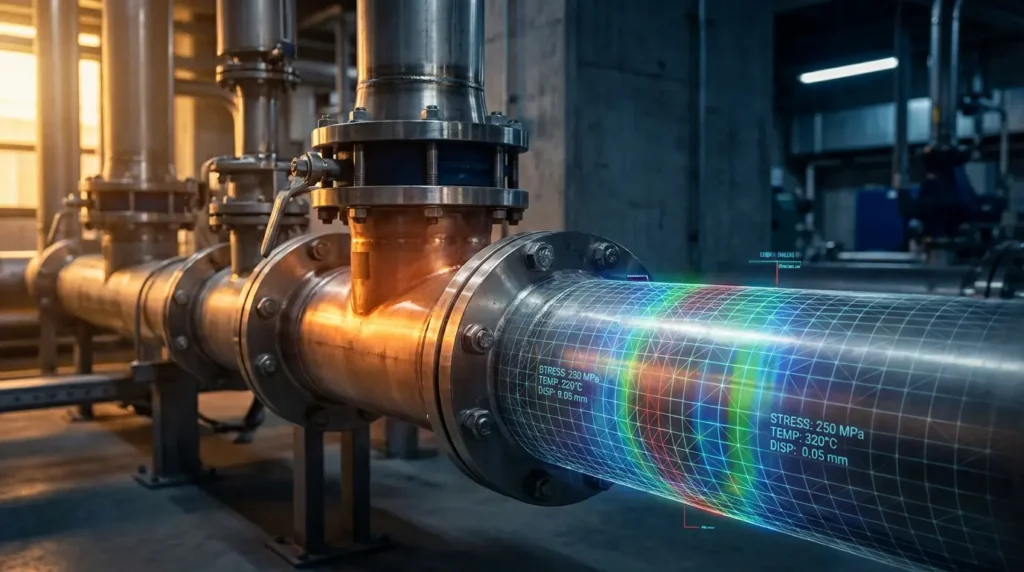
Nuclear energy demands a level of documentation, traceability and regulatory compliance that sets it apart from every other industry. Our team has built deep expertise in this area over many years, and we are a leading competence supplier for nuclear structural analysis in Scandinavia.
We work directly with plant operators, EPC contractors and component manufacturers to ensure that structural designs meet the requirements of ASME and national nuclear safety authorities.
Pipe stress evaluation according to ASME Section III for both dynamically and thermally loaded pipelines
Seismic qualification of safety critical components and systems
Thermal transient analysis for startup, shutdown and accident scenarios
Fatigue assessment of pressure boundaries under cyclic loading
Extensive expertise in regulatory norms and nuclear code compliance
Other industries we serve
Our FEA engineers come from the industries they support. That means they understand not just the analysis methods, but the design constraints, the regulations and the commercial reality of each sector.
Automotive
Structural durability, crash safety, NVH refinement and lightweight design. We support OEMs and Tier 1 suppliers from concept through production validation, covering body in white, chassis, powertrain and battery systems for electric vehicles.
Energy and power generation
Structural integrity assessment of turbines, heat exchangers, pressure vessels and piping systems. Thermal fatigue evaluation for components subject to cycling loads. We help energy companies maintain and extend the life of existing assets while developing new equipment for fossil free power production.
Marine and offshore
Wave loading on offshore structures, fatigue of welded joints, impact analysis for dropped objects, and qualification of subsea equipment. We combine structural analysis with CFD derived load data to provide integrated assessments that reflect actual operating conditions.
Life science
Structural analysis of medical devices, implant mechanics, packaging integrity and pharmaceutical process equipment. Precision and traceability are essential in this sector, and our analysis reports are written to support regulatory submissions.
General manufacturing
From consumer products to heavy machinery, we analyse structures where failure is costly or dangerous. Lifting equipment, pressure equipment, rotating machinery and transport packaging. If it carries a load, we can assess whether the design holds up.
Why customers work with us
We could list capabilities, but what matters more is how we work. Here is what our customers tell us makes the difference.
We bring the right experience, immediately
Our team works on FEA projects every day, across a range of industries. When you bring us a fatigue problem in a welded offshore structure or a thermal stress issue in nuclear piping, we have likely handled something very similar in the past months. That means less ramp up time and fewer wrong turns.
We tell you what the results actually mean
Simulation output without engineering judgement is just coloured pictures. We interpret the results in context, flag the assumptions that matter, and give you recommendations you can act on. If we think the analysis is inconclusive, we say so rather than presenting weak results as strong evidence.
We adapt to how you work
Some customers want a turnkey analysis report delivered in three weeks. Others want a senior FEA engineer embedded in their team for six months. We do both, and everything in between. The format adapts to your project, not the other way around.
We use the right tool for the job
We work with Abaqus, ANSYS Mechanical, LS DYNA, Simcenter Nastran, OptiStruct and more. That means we can pick the solver that fits the physics, not force the problem into whatever software we happen to own. Through our partnership with Volupe, we also offer software licensing, training and HPC cloud solutions.
Common questions about FEA consulting
Everything from straightforward linear static analysis to complex nonlinear problems involving contact, large deformations, material failure and time dependent loading. Our specialities include fatigue assessment, explicit impact simulation, NVH analysis and nuclear code calculations according to ASME standards.
A focused single component analysis with clear load cases can be completed in one to two weeks. Larger projects involving full assembly models, multiple load scenarios and design iteration typically run two to three months. We always define the timeline at project start so there are no surprises.
Yes, this is one of our core strengths. We perform pipe stress evaluation according to ASME Section III, seismic qualification analyses and thermal transient assessments for nuclear installations. Our engineers have extensive experience with the regulatory norms and documentation requirements in this sector.
Absolutely. Fluid structure interaction is one of the areas where we add the most value, precisely because we have both CFD and FEA teams under the same roof. We couple the analyses from the start rather than treating them as separate tasks, which gives better accuracy and avoids the back and forth between different suppliers.
We accept native CAD formats from all major platforms, as well as STEP, IGES and Parasolid files. We also work with existing FE meshes and can import models from other analysis teams. If the geometry needs cleanup or defeaturing before meshing, we handle that as part of the project setup.
Let's discuss your structural analysis needs
Whether you need a quick strength assessment or a long term FEA partnership, we are ready to help. Describe your project and we will get back to you within 24 hours.